LOMOGRAPHY 110 CAMERAS
Lomography is a photographic products distributor and seller in Europe. They sell many unusual, creative cameras and accessories. Some are no longer made, and some are ideas for the future. Here are a few from their current round-up that use 110 film:
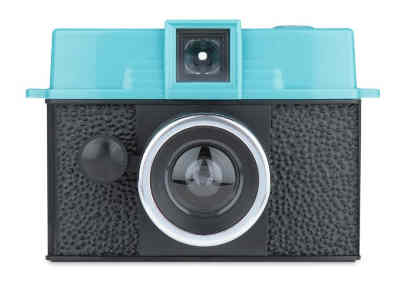
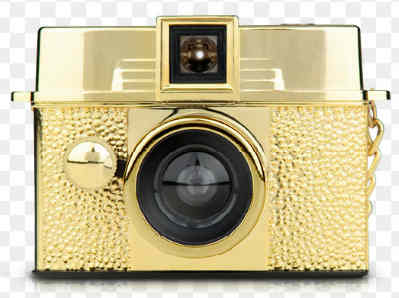
This is a Diana camera that uses 110 film. It has the standard Diana shape with a turquoise top and black bottom, but a "gold" version was also made. Both are all plastic, of course. It uses a non-focusing, plastic, 24mm lens with the aperture set at f8, producing SQUARE images. Everything will be in focus -- as well as a Diana lens can get anything in focus -- from 3 feet to infinity. The User Manual claims that the "Exposure area" is 17x17mm, but since the film is only 16mm wide, you will not have 17x17mm images. The film gate in the camera is 16x17mm, so that's the max -- not bad, but depending on what negative carrier you use, such as 110 (13x17mm) -- the results might be substantially smaller. It has selectable speeds of "N" (1/100) and "B" -- selected by a switch on the camera bottom. They suggest that it is designed for ISO 100 film, but 1/100s at f8 will over-expose that speed film by over two f-stops. This makes the use of slower film -- with finer grain -- possible. And longer exposures are possible with the "B" setting. In addition, low light shots can be made with faster film -- ex. ISO 3200 film at f8 & 1/100s. The shutter button is on the front of the camera. It looks like you should press it to take a picture, but you actually push it down -- like a lever -- a la, a typical Hit-type camera. According to the user manual, it lacks a tripod socket, but there is what looks to be a tiny 1/8", metal socket on the bottom of the film back. The camera does have a PC connection on the top, for any flash that can use a PC cord -- but lacks a shoe. (Perhaps the 1/8" socket is intended for a flash accessory?) With an automatic flash set to f8 for the film speed, this camera can be a super-flexible LOMO-type shooter -- all you need to do is glue a flash shoe to the top of the camera, and the exposures will be perfect in any light. Most interesting is it's interchangeable lens! A 12mm wide-angle (a kinda, sorta, 24-28mm equivalent in 35mm) is available, but may not be sold separately. The lenses have a four-pronged bayonet mount that needs a simple 20° twist to put ON or take OFF. The film is attached to a 110, "key-chain"-type camera, film advancer which attaches to the back of the camera. In essence, the 110 cassette becomes the camera back, as in other keychain 110 cameras. The camera can make multiple exposure, too, adding to its versatility. The film sprockets still lock the film advance, but they do not cock the shutter -- which is always active. The user manual is rather simple, and as a result, getting the film back ON and OFF is quite a challenge. To get it ON, it has to be aligned perfectly with the camera body. There are a couple of tiny grooves that need to be given close attention. Getting the film back OFF of the camera is easier -- although you might never need to do it -- it just requires some tugging and wiggling. The camera comes with a faux camera back -- just used for display. You'll leave the film back ON all the time -- the camera can be loaded and unloaded with the film back in place. The clear, plastic back of the film back (so that you can read the 110 cassette film numbers) ROTATES on one corner, for loading and unloading -- it is not flip up or down, nor slid side-to-side -- which the user manual unfortunately fails to point out. It also has a rather unique viewfinder for both lenses -- 12mm and 24mm -- which the manual also fails to adequately explain. When your eye is close to the viewfinder, you see the view for the 12mm lens. When you move your head back -- about four inches -- a set of black frames appear, and when they are at their sharpest, that is what will be recorded by the 24mm lens. Why not collect all four Diana cameras: the original (for 120 film), 35mm (full frame), half-frame (35mm), and now 110 film?
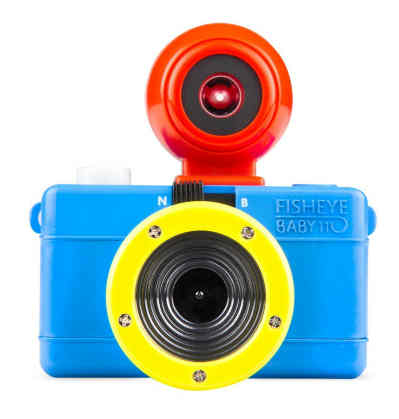
This is a 110 FISHEYE camera! It has the same features as the Diana Baby, but with a 10mm curvilinear lens in a smaller body. With a 170° angle-of-view, it produces 14mm CIRCULAR images on the 110 film. It is normally seen in a multi-colored, plastic body, but a black body with chrome plating was also made.
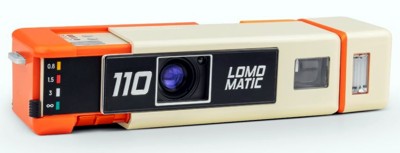
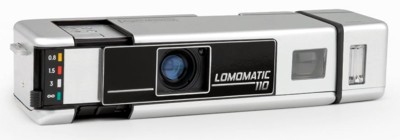
This 110 camera is LOMO's attempt at a serious 110 camera. It's features are fairly unique, but it comes at a price. It's very compact because it uses the collapsing film advance method of the Minolta 16mm and Minox cameras. Yet it has several adjustable exposure features that are unusual in 110 cameras. While it lacks full manual exposure control, it allows you to select three ISO settings, two f-stop settings, and even has a "B" setting for long exposures. While it lacks a tripod socket and cable release, it does offer multiple exposure capability. The shutter is normally set to "A" for automatic shutter speed control. It sports a glass 23mm f2.8 lens -- also unusual in a 110 camera -- and has zone focusing (infinity, 10', 5', 2.5'). A special flash can be attached to the end -- which is so small, it might as well be left on all the time. It was available in two "color" schemes -- white & orange, labeled "Golden Gate", or black & brushed aluminum, labeled "Metal".
Focal Length: 23 mm
Available Apertures: f2.8, f5.6
Shutter Speed: Auto (A) 30s to 1/250, Bulb (B) up to 30s
Flash: Lomomatic 110 flash connection
Available ISO Settings: 100, 200, 400
Multiple Exposure: Yes
Tripod Mount: No
Cable Release: No
Battery: 1 x CR2

To return to the main index for the Sub Club click here.
COPYRIGHT @ 1995-2024 by Joe McGloin. All Rights Reserved.